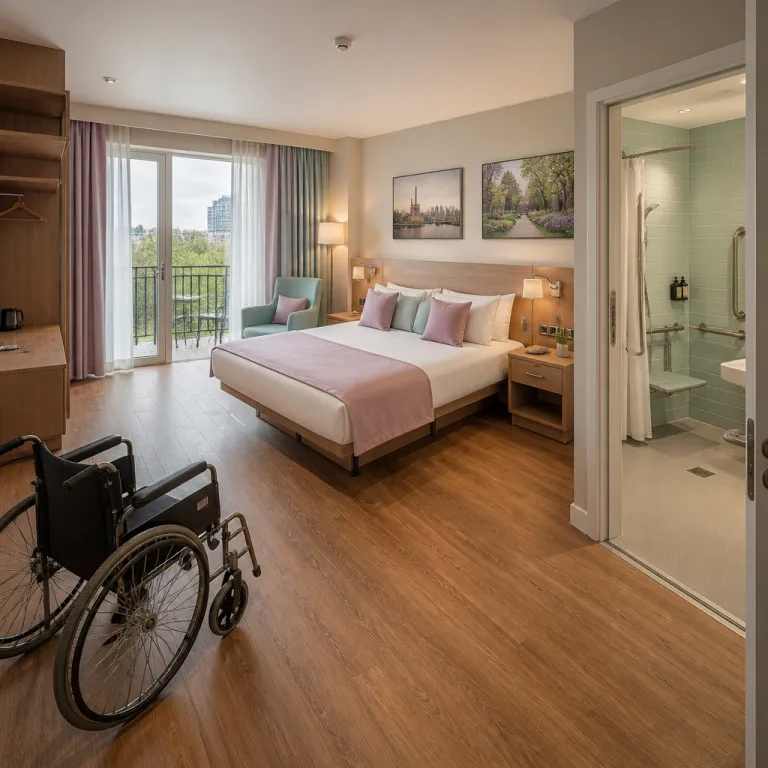
Bankside and South Bank: flat pavements, modern builds, real accessibility
Bankside is where accessible hotels in London for wheelchair users start to feel effortless. The terrain is flat along the Thames, the pavements are wide, and many hotels in this part of the city sit in modern buildings with strong accessibility features designed in from day one. For couples who want art, food and step free riverside walks within a few hundred metres, this is often the best central location.
Hilton London Bankside is the benchmark accessible hotel in this neighbourhood. The property offers genuinely accessible rooms with level thresholds, roll in showers and well positioned grab rails, and the lifts serve every floor without awkward ramps or narrow turns. Typical lift cars in comparable London four and five star hotels measure around 110cm x 140cm, with door widths close to 80cm, which suits most manual and compact power chairs. Guests booking here often mention in their reviews that staff understand wheelchair accessible needs without fuss, which matters as much as any physical feature; one 2023 review on a major booking site praised the team for “replacing a loose shower chair the same evening without drama”.
From Bankside you are around 1.5 miles from Westminster by step free riverside paths. That means you can roll from your London hotel to Tate Modern, cross the Millennium Bridge, then continue towards the royal landmarks without battling kerbs or cobbles. For many guests, this part of central London offers the most relaxed mix of culture, food markets and accessible transport options, with level riverside promenades and frequent resting spots.
The bus network along the South Bank is usually more wheelchair accessible than the Tube. Low floor buses with ramps link Bankside to central London west and to key hubs such as Waterloo, where step free National Rail services connect to the wider United Kingdom. Transport for London publishes an official step free access guide and map for buses, rail and Underground stations, which is updated regularly and should be your starting point when planning routes. When you plan booking accessible stays here, check each hotel website for detailed accessibility statements and confirm accessible rooms by email before you travel, asking for approximate distances in metres from the step free entrance to reception and lifts.
- Best for: flat riverside routes, contemporary architecture, quick access to Tate Modern and the City.
- Check before booking: bathroom layout (roll in shower, grab rails), lift access to all floors, and proximity to bus stops with ramps.
- Typical trade off: modern, reliable accessibility versus slightly less old world London atmosphere.
Accessible hotels in this area tend to be modern, mid to high end properties rather than heritage palaces. That means fewer ornate staircases and more predictable lifts, wider corridors and consistent room layouts that work for both a wheelchair user and a non disabled guest. If you want a comparison with another urban escape that takes accessibility seriously, look at this guide to an accessible luxury city stay and you will see similar priorities around design, service and location.
Kensington and Chelsea: heritage charm, smart retrofits and what really works
Move west into Kensington and Chelsea and the picture changes for accessible hotels in London for wheelchair users. The streets feel more residential, the architecture turns Georgian and Victorian, and many hotels occupy period townhouses that were never designed with step free access in mind. Yet some properties here have invested heavily so that a wheelchair accessible stay still feels indulgent rather than compromised.
The Kensington Hotel in South Kensington is a good example of a luxury hotel London address that has created accessible rooms with care. You still get the classic drawing room atmosphere and a sense of royal neighbourhood elegance, but behind the scenes the lifts, ramps and bathrooms have been reworked to improve accessibility without shouting about it. Typical adapted rooms in this bracket offer door widths of around 80cm, shower areas at least 120cm x 120cm and turning circles close to 150cm. Holiday Inn London Kensington Forum offers another set of accessible rooms in this part of west London, giving guests booking a more contemporary option close to Gloucester Road and the museums.
Copthorne Tara Kensington Hotel is often cited as a pioneering accessible hotel in this district. The property sits slightly back from the busiest streets, which makes vehicle drop off easier for wheelchair users arriving by taxi from other parts of central London. When you read guest reviews, pay attention to comments about room layout, bathroom space and how far the accessible rooms sit from the lifts, because those details shape your daily experience more than any headline feature; one recent guest, for example, noted that the accessible room was “about 40 metres from the lift, with no tight corners”, which made independent access simpler.
Not every hotel address in Kensington has kept pace. Some period properties still rely on portable ramps, narrow lifts or partial step free routes that feel like a service corridor rather than a welcome. Before you commit, use the hotel website to request floor plans of accessible rooms, ask about roll in showers versus shower over bath, and confirm whether grab rails are installed on both sides of the toilet. Where possible, ask for measurements in centimetres rather than vague assurances, so you can compare them with your wheelchair footprint.
- Best for: museum hopping, Hyde Park access and classic London hotel style in a quieter residential setting.
- Check before booking: whether the main entrance is step free, size of the lift, bathroom turning space and type of shower.
- Typical trade off: heritage charm and character versus more complex internal routes and occasional narrow doorways.
For couples who want museums by day and quiet streets by night, Kensington remains one of the most appealing hotel clusters in London. You are a short distance from Hyde Park, the V&A and the Royal Albert Hall, yet still within a few miles of Westminster and the West End by accessible bus. The key is choosing an accessible hotel that has treated accessibility as part of its core design rather than an afterthought, and verifying that the retrofits match your specific mobility needs.
From Westminster to Leicester Square: theatreland, transport and realistic expectations
Between Westminster and Leicester Square you are in the dense heart of London central, where history, politics and theatre collide. The area is packed with hotels, restaurants and attractions, but wheelchair accessible routes can feel fragmented from one block to the next. For accessible hotels in London for wheelchair users, this is where you need to balance romance and practicality very carefully.
Westminster itself offers sweeping views of the river and the royal landmarks, yet many heritage buildings still have steps at their main entrances. Some hotel addresses here have installed discreet platform lifts or created side entrances with step free access, but the experience can vary dramatically from one property to another. Always ask whether the step free route is available 24 hours a day and whether a staff member must operate any lift or door for the guest, because needing to wait for assistance at night can change how independent your stay feels.
Leicester Square and the surrounding streets form the core of theatreland. The pavements are busy, the gradients are mostly gentle, and a number of cinemas and theatres now offer wheelchair accessible seating with companion seats at the same level. When you search for a London hotel near Leicester Square, look for accessible rooms on lower floors in case of lift outages, and check whether the fire evacuation plan includes safe refuge points for wheelchair users. Several recent guest reviews in this area mention staff carrying portable evacuation chairs to refuge areas during drills, which is reassuring when you are assessing emergency procedures.
Transport shapes your stay as much as the hotel. The Tube network around Westminster and the West End has limited step free stations, so many guests rely on buses and taxis instead of underground trains. Transport for London’s step free Tube map shows which stations have level access from street to train and which only offer partial step free routes. Black cabs in the United Kingdom are legally required to be wheelchair accessible, which makes them a reliable option late at night when you return from a show near London Leicester Square.
- Best for: theatre breaks, sightseeing around Parliament and late night dining in the West End.
- Check before booking: emergency evacuation plans, lift redundancy, and how you will travel step free to and from your chosen hotel.
- Typical trade off: unbeatable central location versus patchy step free routes and crowded pavements.
For couples who love city breaks, it can help to compare London with other accessible urban escapes. Guides to an accessible luxury city escape in Bordeaux show how mid sized cities sometimes offer more consistent accessibility than a capital packed with heritage buildings. In London, the trade off is clear; you gain world class culture and nightlife, but you must curate both your accessible hotel and your daily routes with more precision.
King's Cross and St Pancras: gateway to Europe with new build confidence
King's Cross and St Pancras form the most important arrival point for many wheelchair users entering London from elsewhere in the United Kingdom or from mainland Europe. The Eurostar terminal at St Pancras has step free routes, assistance services and level boarding, which sets the tone for the surrounding streets. Around the stations, a wave of regeneration has created new build hotels with strong accessibility baked into their design.
For accessible hotels in London for wheelchair users, this neighbourhood offers a practical mix of price points and styles. Many hotel properties here are part of international groups such as IHG, which has made a public commitment to improving accessibility across its portfolio. That often translates into accessible rooms with consistent layouts, roll in showers, grab rails and visual alarms, even if the décor feels more functional than romantic. Several branded hotels in this area publish accessibility statements that list door widths, alarm types and the number of adapted rooms, which makes comparison easier.
The streets immediately around King's Cross are mostly step free, with dropped kerbs and wide crossings. Granary Square and the canalside paths offer level routes for an evening roll, and the area sits only a few miles north of Westminster and the West End by accessible bus. When guests booking a London hotel here plan their days, they often combine local restaurants with quick trips to museums in South Kensington or galleries in central London west, using direct bus routes to avoid complex interchanges.
Transport is the main advantage of this district. You have National Rail, Eurostar and multiple bus routes on your doorstep, so you can avoid the more challenging parts of the Tube network while still reaching most parts of the city. For couples planning longer itineraries across Europe, staying near King's Cross can turn a London stopover into a smooth, wheelchair accessible hub rather than a stressful transfer, especially when you know the distance from the station’s step free exit to your hotel entrance in advance.
- Best for: rail and Eurostar connections, value conscious stays and easy access to multiple London neighbourhoods.
- Check before booking: distance from the step free entrance to reception and lifts, noise levels from the station, and availability of visual alarms.
- Typical trade off: excellent connectivity and modern accessibility versus a slightly more functional hotel atmosphere.
When you compare hotel choices here, look beyond the star rating. Read guest reviews that mention accessibility, ask the hotel about the distance in metres from the step free entrance to the lifts, and confirm whether accessible rooms are guaranteed at the booking stage or only on arrival. A well located, genuinely accessible hotel near King's Cross can anchor an entire multi country journey.
Royal Lancaster, Bankside and beyond: specific properties wheelchair users rate highly
Names matter when you are choosing accessible hotels in London for wheelchair users. Across the city, many hotels currently advertise accessible rooms, but only a smaller group consistently earns good feedback from guests who travel with mobility aids. The difference usually lies in the details; not just step free access, but how the team responds when something goes wrong.
Royal Lancaster London, overlooking Hyde Park, is one of the most frequently praised properties. Guests highlight its spacious accessible rooms, generous turning circles and bathrooms with roll in showers and solid grab rails, all within a calm central location that still feels close to the action. One 2022 review noted that staff “measured the bed height on request before arrival” so the guest could decide whether to bring a portable hoist. From here you are a short bus ride to Westminster, a few miles from the museums of Kensington, and within easy reach of the West End.
Hilton London Bankside, mentioned earlier, stands out for its combination of modern design and thoughtful accessibility features. The accessible rooms are integrated across different floors rather than hidden in a basement, and the public spaces remain easy to navigate even when the hotel is busy. For couples, that means you can move from bar to restaurant to room without constantly planning every turn, and reviews often mention staff proactively offering to store mobility scooters near reception with access to charging points.
In Kensington, The Kensington Hotel and Copthorne Tara Kensington Hotel offer contrasting but complementary options. The former delivers a classic London hotel atmosphere with carefully adapted accessibility, while the latter has a more contemporary feel and a reputation as an early adopter of wheelchair accessible design. Holiday Inn London Kensington Forum adds another layer of choice, especially for guests booking with loyalty points who still expect reliable accessibility.
Across these properties, patterns emerge. Staff training, clear information on the hotel website and honest pre arrival communication matter as much as physical features. When you shortlist hotel options, prioritise those where previous guest reviews mention specific accessibility wins rather than vague comments about being "accessible". A simple comparison can help:
- Royal Lancaster London: spacious adapted rooms, strong views over Hyde Park, calm but central location.
- Hilton London Bankside: flat riverside setting, modern design, accessible rooms spread across floors.
- The Kensington Hotel: heritage style, discreet retrofits, close to museums and South Kensington.
- Copthorne Tara Kensington Hotel: early focus on accessibility, easier vehicle drop off, residential surroundings.
- Holiday Inn London Kensington Forum: chain hotel consistency, loyalty points, practical access to Gloucester Road.
How to read reviews, plan routes and book with confidence
Finding accessible hotels in London for wheelchair users is only half the story. The rest lies in how you interpret information, from glossy marketing photos to terse accessibility statements. A luxury stay becomes truly relaxing when the reality matches your expectations from the moment you arrive at the hotel.
Start with the hotel website, but do not stop there. Look for a dedicated accessibility page that lists step free entrances, lift dimensions, bathroom layouts and the number of accessible rooms, then cross check that data against independent reviews from wheelchair using guests. When possible, email the property with a short list of precise questions about roll in showers, grab rails, bed height and space for hoists, and ask for measurements in centimetres so you can compare them with your own equipment.
Transport planning is just as important. In central London, buses are usually more consistently wheelchair accessible than the Tube, while black cabs provide a flexible option late at night or in areas with fewer step free stations. For some couples, staying slightly west or north of the absolute centre, then using reliable bus routes into Westminster or Leicester Square, offers a better balance between calm streets and easy access. TfL’s official journey planner allows you to filter for step free routes, which can save time and energy once you are on the ground.
Remember that not all accessibility icons mean the same thing. Some hotel properties use the wheelchair symbol for any room on a lower floor, even if the bathroom still has a shower over bath and no grab rails. When you are booking accessible stays, insist on written confirmation that your room has a roll in shower, level access and enough space around the bed for your specific wheelchair, and keep that email or message as a reference at check in.
Finally, think about your wider accessible travel portfolio. If you enjoy urban escapes with strong accessibility, you might also appreciate the way this accessible luxury cave hotel in Matera handles design and service for wheelchair users. The common thread is simple; the best accessible hotels treat every guest as a guest first, and then quietly ensure that the details of accessibility are handled with precision and respect.
Key figures on accessible hotels in London
- Industry surveys suggest that more than a hundred hotels in London currently advertise accessible rooms, reflecting a growing but still limited pool of genuinely accessible options in such a large city.1
- Accessibility audits indicate that a high proportion of these hotels provide some form of step free access at the entrance, yet the quality of internal accessibility, such as bathroom design and lift access, varies widely between properties.1
- Specialist travel advisers report an increasing number of hotels offering accessible rooms each year, mirroring rising demand from guests who expect accessibility to match other luxury features rather than sit as an afterthought.2
- Advisers consistently recommend that wheelchair users verify accessibility features directly with the hotel and consider proximity to accessible public transport, because location and routes can make as much difference as room design.2
1 Based on aggregated findings from UK accessibility audits, Transport for London step free access data and tourism statistics rather than a single official report. 2 Drawn from guidance published by specialist accessible travel agencies and disability travel organisations.
FAQ about accessible hotels in London for wheelchair users
Which hotels in London offer wheelchair accessible rooms ?
Hotels like The Kensington Hotel, Copthorne Tara Kensington Hotel, Royal Lancaster London, Hilton London Bankside and Holiday Inn London Kensington Forum all offer wheelchair accessible rooms with varying levels of adaptation. These properties combine central or near central locations with specific accessibility features such as roll in showers and grab rails. Always confirm the exact room type and layout directly with the hotel before finalising your booking, and ask for recent photos of the specific category you will be assigned.
What features should I look for in an accessible hotel room ?
Look for step free access, roll in showers, grab rails, and emergency assistance alarms. You should also check bed height, space around the bed for transfers, and whether light switches and thermostats are reachable from a seated position. If you use a hoist or other equipment, ask about under bed clearance and power outlets near the bed, and request measurements in centimetres so you can compare them with your own kit.
How can I confirm a hotel's accessibility features ?
Contact the hotel directly or check their official website for detailed accessibility information. Ask for photos or floor plans of the specific accessible room category you are booking, not just generic images. It is also wise to read recent guest reviews from wheelchair users, which often highlight practical details that official descriptions omit, such as the distance from reception to the lift or how staff handled a broken shower chair.
Is public transport in London suitable for wheelchair users staying in central hotels ?
Public transport in London offers a mix of accessible and less accessible options. Many bus routes in central London are wheelchair accessible with low floors and ramps, while the Tube has a more limited number of step free stations, especially in older central areas. Taxis, particularly black cabs, provide an important wheelchair accessible alternative for journeys where buses or trains are less practical, and TfL’s accessibility tools can help you identify the most suitable routes.
Why do some accessible hotels in London feel more comfortable than others ?
The comfort level often depends on how deeply accessibility has been integrated into the design and operation of the hotel. Properties that consult accessibility specialists, train staff thoroughly and retrofit heritage buildings with care usually deliver a smoother experience than those that add minimal adaptations. Reading detailed reviews and asking specific questions before booking helps you identify the hotels that truly prioritise accessibility, so your stay feels like a luxury break rather than a compromise.