Le Marais: flat streets, refined stays and reliable access
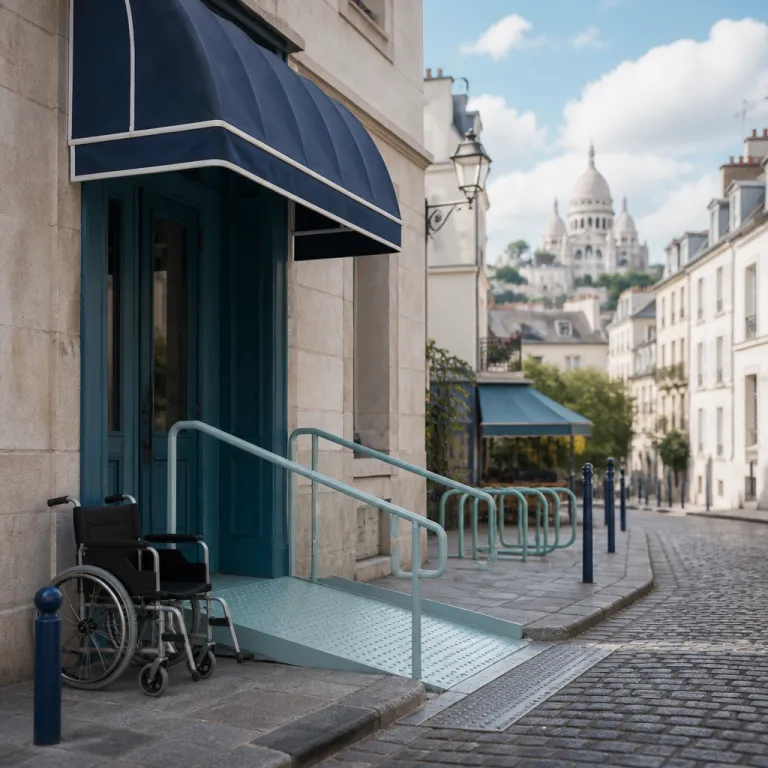
Le Marais is one of the most forgiving districts in Paris for a wheelchair user. Streets are relatively flat, pavements are narrower than in newer areas yet still manageable, and several bus and Métro lines with lift access connect this historic quarter to the Louvre and the Eiffel Tower. For many couples planning accessible travel, this balance of charm, accessibility and short roll distances to major sights makes Le Marais an ideal base for a first trip.
Maison Proust in Le Marais is a luxury accessible hotel that shows how heritage architecture and modern accessibility can coexist. The property offers accessible rooms with level access from the street, wide doors and bathrooms with roll showers, grab bars and space for a wheelchair to turn. When you compare accessible hotels in Paris, focus less on star ratings and more on whether accessible rooms are located near lifts, how the staff handle requests and whether the website clearly details room measurements rather than vague promises.
From an accessible Paris perspective, Le Marais works beautifully if you plan your days around short, elegant loops. You can roll from your Paris hotel to the Seine, continue towards Notre Dame for a photo stop, then cross to Île de la Cité using curb cuts that have been upgraded since the Olympic accessibility push. Buses with low floors link Le Marais to the Louvre Museum and to accessible hotels near the Champs Élysées, while taxis with ramps remain the most comfortable option after a long museum tour.
What to look for in Le Marais hotels
When browsing hotels Paris in this district, filter for at least one fully wheelchair accessible room with a verified roll in shower. Ask the hotel for photos of the bathroom, including the roll showers area, the position of grab bars and the space beside the toilet for lateral transfers. A serious accessible hotel will have trained staff who can answer these questions quickly and will not hesitate to send detailed images.
Couples often underestimate how much energy is saved by choosing rooms Paris that are close to the lift and breakfast area. In a dense city like Paris, every extra roll down a corridor or ramp adds up over a three or four night stay. When you book, request accessible rooms on lower floors in case of lift breakdowns and confirm that emergency evacuation plans include disabled guests using wheelchairs.
Le Marais also offers accessible restaurants and cafés where staff are used to international accessible travel expectations. Terraces sometimes have a small step, yet many venues now provide portable ramps and will rearrange tables to create clear access routes. Before you travel, check the hotel website for specific accessibility information and consider emailing a short list of questions about room access, lobby steps and the route from the taxi drop off point.
Right bank classics: Louvre, Opéra and the Champs Élysées
Staying near the Louvre and Opéra places you at the geographic heart of Paris, with wide boulevards that are easier to roll along than the medieval lanes of the Latin Quarter. Pavements here are generally smoother, crossings are better signposted and several bus routes with wheelchair access connect directly to the Eiffel Tower and the Musée d’Orsay. For couples who want a classic Paris hotel experience with minimal daily transfers, this central zone works particularly well.
When you search for accessible hotels in this area, pay close attention to how each hotel describes its accessible rooms and public spaces. Some Paris hotels occupy Haussmann era buildings where retrofitting lifts and step free access has been complex, so you may find that only part of the property is truly wheelchair accessible. Ask whether the main entrance is level, whether there is ramped access to the breakfast room and whether any internal steps separate the lobby from the lifts.
Many travellers choose a hotel near the Louvre Museum because it reduces the need for long Métro journeys. The Louvre itself offers step free access, adapted toilets and staff trained to support disabled visitors, yet the surrounding streets can still feature uneven cobblestones. A central accessible hotel allows you to roll to the museum in ten to fifteen minutes, return to your room for a rest, then head out again for an evening tour along the Seine towards the Eiffel and the glittering skyline.
Champs Élysées and the Élysées hotel question
The Champs Élysées corridor, stretching from Place de la Concorde to the Arc de Triomphe, is lined with luxury hotels Paris that appeal to couples seeking a romantic city break. Sidewalks here are wide, crossings are signalised and curb cuts are generally well maintained, which makes it easier to roll between your Paris hotel, nearby restaurants and accessible shops. When evaluating any Élysées hotel, ask specifically about wheelchair accessible rooms, roll in showers and whether the entrance from the avenue is step free or via a side door.
Some accessible hotels along the Champs Élysées offer spectacular views of the Eiffel Tower from higher floors. These rooms Paris often book out quickly, so reserve early and confirm that the accessible rooms with views also include grab bars, lowered wardrobe rails and enough space for a wheelchair to turn beside the bed. If a property offers accessible rooms only on lower floors without views, decide whether the trade off between scenery and easier evacuation feels right for your trip.
For couples who enjoy curated city breaks, it can help to compare Paris wheelchair experiences with other destinations that prioritise accessible luxury. Guides such as the romantic weekend planning resource for accessible luxury stays in Illinois show how thoughtful hotel design can transform a short trip into a restorative escape. Use that same critical lens when reading each hotel website in Paris, looking for concrete accessibility details rather than generic claims.
Left bank and the Latin Quarter: romance with caveats
The Left Bank, including Saint Germain and the Latin Quarter, delivers the Paris of café terraces, bookshops and riverside strolls. For wheelchair users, this area is a mix of gentle riverfront paths and challenging side streets with narrow pavements and occasional steep cambers. Couples who prioritise atmosphere over absolute ease of movement often accept a little extra effort here in exchange for evenings spent rolling along the Seine with Notre Dame illuminated ahead.
When you evaluate accessible hotels on the Left Bank, focus on micro geography rather than arrondissement stereotypes. A Paris hotel one block closer to the river can mean a mostly flat roll to the nearest bridge, while a property further uphill might require tackling several sloping side streets. Ask hotels for a video of the route from the nearest accessible taxi drop off point to the lobby, including any ramps, cobblestones or temporary obstacles.
Notre Dame and its surrounding Île de la Cité remain a focal point for many accessible travel itineraries. The bridges leading to the island have improved curb cuts, yet some approaches still feature uneven surfaces that can be tiring when you push a wheelchair. Choosing accessible hotels within a short roll of the river allows you to enjoy these views without committing to long, unpredictable journeys through crowded backstreets.
Haussmann buildings and the accessible Paris reality
Across both banks, many Paris hotels occupy Haussmann era buildings with grand staircases and narrow original lifts. This heritage architecture creates a specific accessibility challenge, because retrofitting full step free access and spacious accessible rooms is technically complex and expensive. As a result, some properties advertise an accessible hotel status based on a single adapted room and a portable ramp at the entrance, which may not meet the expectations of wheelchair accessible travellers.
To navigate this, ask very precise questions before you book any accessible hotel in Paris. Request the exact dimensions of the accessible rooms, the width of doors, the turning circle in the bathroom and the height of the bed from the floor. Confirm that the roll showers are truly level entry, with no lip at the threshold, and that grab bars are fixed securely on both sides where possible.
It helps to cross check hotel claims with independent accessibility guides and wheelchair travel organisations that maintain updated lists of accessible hotels. One such resource notes that there are 233 verified wheelchair accessible hotels in Paris, which gives a sense of the scale of choice yet also underlines the need to filter carefully. When a hotel website offers only vague references to accessibility, treat that as a prompt to ask more questions rather than a reassuring sign.
Montmartre: hills, views and carefully chosen bases
Montmartre is one of the most visually dramatic districts in Paris, yet its steep hills and staircases can be punishing for wheelchair users. Cobblestone lanes, sloping pavements and sudden steps make spontaneous exploration difficult, so the choice of hotel and the exact street it sits on become critical. Couples who love the idea of Sacré Coeur views should approach this area with a clear strategy rather than romantic improvisation.
Two properties stand out in Montmartre for their commitment to accessibility. Hôtel Le Montmartre Saint Pierre offers accessible rooms with adapted bathrooms, while Holiday Inn Paris Montmartre provides chain hotel predictability with wheelchair accessible rooms and step free access to public areas. Both hotels illustrate how an accessible hotel in a challenging topography can still deliver a comfortable base, provided you plan your daily roll routes carefully.
Montmartre’s terrain means that even short distances on a map can translate into strenuous pushes in reality. Before booking, ask each hotel for details about the slope of the street outside, the distance to the nearest accessible bus stop and whether taxis can stop directly at the entrance. When a property confirms that the route from the lobby to the accessible rooms is entirely step free, including any breakfast or bar areas, you can then decide whether the surrounding hills feel manageable for your trip.
Moving between Montmartre and central Paris
For many couples, the ideal Paris wheelchair strategy involves staying in a more accessible central district and visiting Montmartre as a focused half day tour. Accessible taxis and some bus routes make this feasible, allowing you to roll around key viewpoints without committing to the area’s steepest streets. If you do choose to stay in Montmartre, consider splitting your trip so that only one or two nights are spent on the hill, with the rest based in flatter neighborhoods.
Holiday Inn Paris Montmartre, as a chain property, often provides clearer accessibility information on its website than smaller independent hotels. Look for explicit mentions of accessible rooms, roll in showers, grab bars and lowered reception desks, as well as confirmation that public toilets in the lobby are wheelchair accessible. When staff respond quickly and precisely to accessibility questions, it signals a culture that understands disabled guests as part of their core clientele rather than an afterthought.
Montmartre’s charm is undeniable, yet it is not the easiest place for accessible travel. If you are used to destinations where every curb cut is perfect and every Métro station has a lift, Paris will feel more improvised and sometimes frustrating. Balancing one or two high effort days in Montmartre with lower effort days near the Louvre Museum or the Champs Élysées can keep the overall trip enjoyable.
From airports to your hotel: transfers, metro lines and taxis
Arriving in Paris with a wheelchair means planning your route from Charles de Gaulle or Orly to your accessible hotel with care. Standard taxis are not always suitable for larger power chairs, and not every train or Métro connection offers step free access. Couples who invest time in this first logistical step often find the rest of the trip flows more smoothly.
Wheelchair accessible taxis and private transfer services operate from both airports, offering vehicles with ramps or lifts and secure tie down systems. These services cost more than regular taxis yet deliver door to door access to your Paris hotel, which is invaluable after a long flight. When booking, confirm the dimensions of your wheelchair, whether you will remain seated during the journey and whether the driver is trained in securing disabled passengers safely.
Public transport has improved significantly, with nine fully accessible Métro or RER lines serving key parts of the city. However, accessibility is not uniform, and some stations still lack lifts or have unreliable ones, which can trap wheelchair users on platforms. Before relying on the Métro, cross check the latest accessibility maps and consider using buses, which generally offer low floor access and designated wheelchair spaces.
Choosing neighborhoods based on transport accessibility
When you compare accessible hotels Paris wheelchair options, think in terms of daily journeys rather than just airport transfers. A hotel near an accessible RER station might simplify your arrival yet complicate your visits to the Louvre, the Eiffel Tower or Notre Dame if the connecting lines are not step free. In contrast, a property near several accessible bus routes can make it easier to roll directly to museums, restaurants and river cruises.
Accessible travel insurance is another often overlooked element of planning. Policies that cover mobility equipment, medical emergencies and trip interruptions provide a safety net if a lift fails or a ramp breaks, forcing last minute hotel changes. When you book through a specialist website that focuses on accessible hotels, you may also find curated advice on insurance providers familiar with disabled travellers’ needs.
Paris wheelchair experiences vary widely depending on how much you rely on public transport versus taxis. Couples who budget for a mix of accessible taxis, buses and occasional Métro rides at fully accessible stations usually report less stress. Whatever your strategy, keep a backup plan for each day, including alternative routes and the contact details of your hotel staff in case you need assistance returning.
Curated accessible luxury: how to read hotel websites and reviews
Finding genuinely accessible hotels in Paris requires reading between the lines of glossy marketing language. A hotel website might feature a wheelchair symbol yet provide no details about room dimensions, roll in showers or grab bars, which should immediately prompt further questions. Couples seeking premium experiences need information that goes beyond compliance checklists to describe how an actual stay will feel.
Start by scanning each Paris hotel page for a dedicated accessibility section that lists accessible rooms, public area access and any limitations. Look for phrases such as step free access from street to room, roll in showers with handheld showerheads, and accessible toilets with side and rear grab bars. When a property describes the exact number of accessible rooms and their location relative to lifts, it usually indicates a more serious approach to accessibility.
Independent reviews from disabled travellers and wheelchair travel organisations can help verify these claims. Some guides specialise in accessible hotels and accessible rooms, offering photos and measurements that complement official descriptions. Comparing Paris wheelchair experiences with other destinations covered by the same platform, such as refined accessible stays on North Carolina’s Outer Banks, can sharpen your sense of what good accessibility looks like in practice.
What premium really means for disabled guests
In the luxury segment, premium should mean that disabled guests receive the same quality of experience as everyone else. That includes being able to roll into the lobby through the main entrance, enjoy the bar and restaurant without detours and access spa or pool areas where hoists and ramps actually work. It also means that staff are trained to interact with wheelchair users confidently and respectfully, without overhelping or ignoring them.
When you read reviews of accessible hotels Paris wheelchair options, pay attention to comments about staff behaviour and problem solving. A hotel that responds quickly when a lift fails, offers alternative rooms or arranges accessible taxis shows a level of service that matters more than marble lobbies. Conversely, repeated complaints about blocked ramps, inaccessible breakfast rooms or staff who do not understand disabled guests’ needs are red flags.
For couples who enjoy planning, mapping out accessible hotels in different cities can become part of the pleasure of travel. Resources that provide elegant guides to accessible luxury hotel maps in cities like New Orleans demonstrate how thoughtful curation can save hours of research. Use those same principles when building your own shortlist of Paris hotels, focusing on neighborhoods that match your mobility needs and your idea of romance.
Statistics: key figures for accessible hotels and transport in Paris
- There are 233 verified wheelchair accessible hotels in Paris, according to wheelchair travel organisations that track accessible accommodations across the city.
- Nine public transport lines in Paris are considered fully accessible, which significantly improves step free connections between some neighborhoods and major attractions such as the Louvre Museum and the Eiffel Tower.
- Accessible hotels are concentrated in central arrondissements, yet districts like Montmartre still offer several adapted properties, illustrating a gradual spread of accessibility beyond the traditional tourist core.
- Paris has invested heavily in accessibility upgrades to pavements, crossings and public buildings, creating more reliable curb cuts and step free routes around landmarks like Notre Dame and the Champs Élysées.
- The growing number of accessible rooms in Paris hotels reflects a wider trend in accessible travel, as more couples with disabilities choose independent city breaks rather than organised group tours.
FAQ: accessible hotels in Paris for wheelchair users
Are there wheelchair accessible hotels in Le Marais ?
Yes, Maison Proust is an accessible hotel in Le Marais. This property offers adapted rooms and step free access, making it a strong option for couples who want a central yet atmospheric base. Always confirm current accessibility details directly with the hotel before booking.
Is Montmartre suitable for wheelchair users ?
Montmartre has steep hills; accessible hotels like Hôtel Le Montmartre Saint Pierre are available. The terrain remains challenging, so many wheelchair users choose to visit Montmartre for a day rather than stay there for an entire trip. If you do stay, pick a hotel on a less steep street and plan your routes carefully.
How many wheelchair accessible hotels are there in Paris ?
Recent research by wheelchair travel organisations indicates that there are 233 verified wheelchair accessible hotels in Paris. This figure covers a range of categories, from luxury properties near the Champs Élysées to chain hotels in districts like Montmartre. The number continues to grow as more hotels upgrade rooms and public areas.
Which Paris neighborhoods are easiest for wheelchair users ?
Le Marais, the area around the Louvre and parts of the Champs Élysées corridor are generally easier for wheelchair users than hillier districts. These neighborhoods offer flatter streets, better curb cuts and more accessible hotels within short roll distances of major sights. Montmartre and some Latin Quarter backstreets remain more challenging due to slopes and uneven pavements.
What should I ask a hotel before booking an accessible room in Paris ?
Ask about step free access from the street to the room, the exact dimensions of doors and bathrooms, and whether the shower is a true roll in design. Confirm the presence and placement of grab bars, the bed height and the location of accessible rooms relative to lifts. It is also wise to ask about emergency evacuation procedures for disabled guests and the availability of accessible taxis nearby.