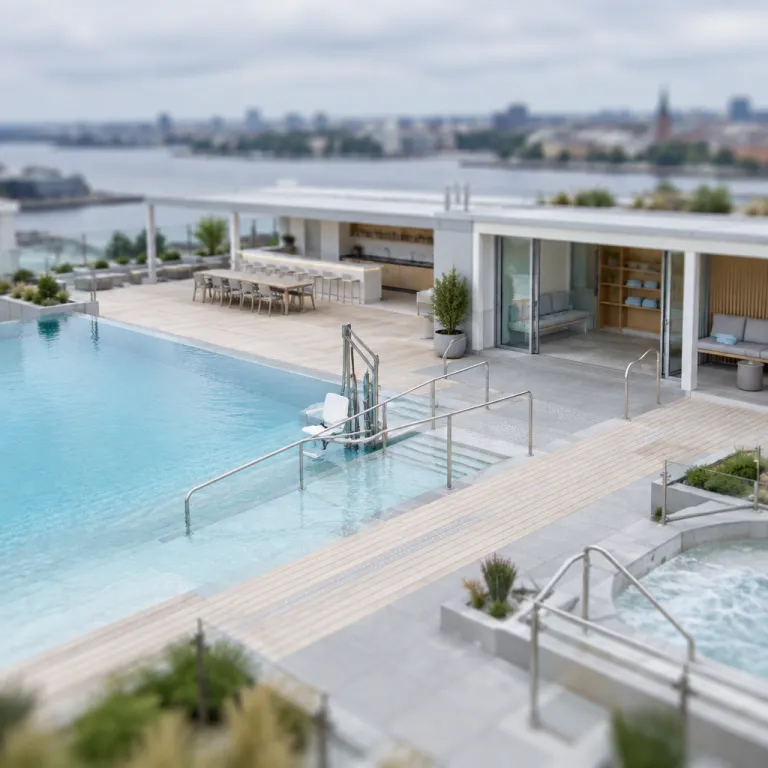
Why accessible luxury must include the rooftop, pool, and spa
Luxury travel only feels complete when every guest can reach the same rooftop bar, infinity pool, and spa circuit. For wheelchair users and guests who need mobility-accessible design, the reality is that these headline amenities are often the first spaces where the promise of an inclusive high-end stay quietly falls apart. Leading premium hotels now recognise that accessibility features are not add-ons but core elements of brand integrity, especially when couples arrive expecting romance, skyline views, and seamless service.
Across major hotel markets in New York, Austin, Beverly Hills, Baltimore, Miami, and beyond, the most forward-thinking general managers now audit every route from lobby to rooftop pool, from accessible rooms to hammam, with the same rigor they apply to revenue per available room. Industry surveys, guest reviews, and third-party accessibility audits consistently show that satisfaction with accessibility rises sharply when the pool, spa, and rooftop bar are fully usable without assistance. This shift aligns with the rise of experiential luxury, where the value lies less in the size of the king room and more in whether you can share that sunset cocktail or heated pool swim together.
For couples booking a romantic stay, the question is no longer whether a hotel has a pool or spa, but whether the accessible room connects via step-free routes to those spaces and whether pool access is dignified, independent, and reliable. A property that promotes a dramatic city skyline from its rooftop but hides a single step at the terrace door is not an accessible hotel in any meaningful sense. The new benchmark is simple yet demanding: every guest should reach the rooftop, glide into the infinity pool, and enjoy the spa circuit without feeling like a problem to be solved.
Rooftop bars and skyline views without the elevator gap
Rooftop bars sell a fantasy: the city skyline at your feet, a crafted cocktail in hand, and the sense that you are exactly where you should be. For wheelchair users, that fantasy collapses the moment an elevator stops one floor short of the rooftop or a narrow doorway blocks the final metres to the terrace, turning a promised accessible rooftop experience into a broken commitment. The most credible luxury hotels now design the rooftop route first, ensuring that the lift, ramps, and circulation space work for guests with mobility needs before they commission the bar counter or the Instagram-ready firepit.
In New York and Miami, several design-forward properties have become reference points because the elevator opens directly onto the rooftop pool deck, with wide turning circles and level thresholds that respect both wheelchair users and guests with canes. Their rooftop pool layouts prioritise clear paths between loungers, bar, and heated pool, so a couple can move from accessible rooms to terrace without staff choreography or awkward detours through service corridors. Under U.S. standards such as the 2010 ADA Standards for Accessible Design, this typically means door clearances of at least 32 inches (81 cm) and continuous routes without steps, so skyline views are identical whether you arrive on wheels, with a stroller, or on high heels.
Design details matter here, from table heights that accommodate a wheelchair user’s knees to bar stools that can be removed quickly without drama. A dedicated concierge team that understands rooftop access, rather than just restaurant reservations, can quietly arrange the best tables with unobstructed city skyline panoramas and enough space for a turning circle. For deeper guidance on how thoughtful design, such as elegant spa steps with a handrail or graded ramps, can transform shared spaces, resources like this analysis of accessible spa steps and handrails in luxury hotels show how aesthetics and accessibility can coexist beautifully.
Case study: rooftop access done well
One published accessibility audit of the rooftop at the Sagamore Pendry Baltimore describes a direct elevator connection to the terrace, 36-inch (91 cm) clear door openings that exceed ADA minimums, and at least 60 inches (152 cm) of turning space at key junctions. Tables are spaced to maintain a minimum 36-inch route, and at least one seating zone at the edge of the terrace is reserved for step-free access. Floor plans and captioned photos in the audit verify these measurements, giving guests confidence that the skyline experience will be genuinely shared.
Pools that prioritise dignity: from heated rooftop pools to infinity edges
The pool is often the emotional centre of a luxury stay, especially for couples chasing late afternoon light and quiet conversation. When that pool sits on a rooftop, with a city skyline or ocean horizon stretching beyond the edge, it becomes the defining image of a high-end urban resort. Yet for many wheelchair users, the question is painfully simple: can I get into the water without feeling exposed, dependent, or unsafe?
Accessible pool design now revolves around three main solutions: self-operating lifts, staff-operated hoists, and sloped or beach-style entries that allow a wheelchair user to roll or walk gradually into a heated pool or infinity pool. Self-operating lifts offer the greatest independence, especially when controls are within easy reach and staff are trained to explain them without fuss, while sloped entries can feel more natural for guests with limited mobility who prefer to walk with support. Staff-operated hoists can still work well in a luxury context, but only when the équipe is discreetly trained, the equipment is maintained, and the process feels as choreographed as a spa ritual rather than a medical procedure.
Resorts with rooftop infinity pools and elevated heated pools increasingly show how design and engineering can deliver both drama and robust accessibility features. Under ADA pool regulations, for example, a primary accessible means of entry is required for larger pools, and many hotels now exceed these baselines by adding secondary options such as transfer walls or sloped entries. Some properties publish details such as lift weight limits, transfer seat heights, and the presence of handrails or shallow ledges, allowing guests to match their own needs to the available equipment. Couples planning an intimate escape with hydrotherapy or a private whirlpool can also look to curated guides such as this review of romantic hotels with accessible jacuzzi suites, which highlight where pool access and in-room spa experiences genuinely align.
Case study: documenting pool accessibility
In one publicly available hotel accessibility statement for a coastal resort in Miami Beach, the main pool is described as having a self-operating lift with a 300 lb (136 kg) capacity, armrests, and a footrest, positioned on a deck reached via a 1:20 ramp. The route from accessible rooms to the pool is step-free, with door thresholds under 1/2 inch (13 mm), in line with ADA guidance on level changes. A nearby shower includes a fold-down bench at transfer height and grab bars on two walls. This level of specific, verifiable information, ideally supported by simple diagrams or photos, turns a marketing image of a rooftop or infinity pool into a realistic, low-stress option for guests with mobility needs.
Spa and wellness circuits designed for every body
While pools and rooftops dominate the marketing images, the spa is where many couples quietly invest the most emotional energy during a luxury stay. A genuinely accessible luxury hotel must treat the wellness circuit, from sauna to treatment room, as a fully shared experience rather than a consolation prize for guests who cannot reach the rooftop bar. That means starting with the basics: step-free routes, wide doorways, and treatment rooms large enough for a wheelchair to turn without rearranging half the furniture.
Accessible spa design goes further, with adjustable-height treatment tables, roll-in showers equipped with a secure hand-held shower, and benches at transfer height near hydrotherapy pools. When a spa includes a steam room or sauna, the entrance should be level, the seating varied in height, and the emergency call systems reachable from a seated position, ensuring that guests with mobility needs can enjoy the same heat rituals as everyone else. Sensory-friendly options, such as dimmable lighting, quieter relaxation rooms, and therapists trained to communicate clearly with guests who are deaf or neurodivergent, round out a wellness offer that respects different bodies and minds.
Leading properties in cities like Miami and New York increasingly integrate their spa, fitness center, and rooftop pool into a single, coherent wellness journey that does not break down at the first step or narrow doorway. Their fitness center layouts allow wheelchair users to move between cardio machines and free weights without feeling like an obstacle, while spa reception desks are low enough for eye-level conversation. For couples travelling with power wheelchairs or complex equipment, planning the logistics of charging, transfers, and spa access in advance is essential, and resources such as this guide to travelling with a power wheelchair and hotel logistics can make the difference between a stressful stay and a restorative one.
How to read listings and ask the right questions before you book
For couples browsing a premium booking website, the phrase “accessible luxury” should be a starting point, not the end of your research. Many hotels still rely on generic accessibility icons or vague mentions of accessible rooms, leaving guests to guess whether the rooftop pool, spa, and bar are actually usable without stairs or awkward side entrances. The most reliable properties now publish detailed accessibility features, including whether the rooftop is reached by elevator, whether the pool has a self-operating lift or sloped entry, and whether spa treatment rooms can accommodate a wheelchair and a partner comfortably.
When you check rates for a city break in New York, Austin, or another major city, look beyond the headline offers and read the fine print on room categories and amenity access. A king room with skyline views means little if the route to the rooftop bar includes a step, or if the infinity pool lift is out of service for half the summer season, so do not hesitate to email the hotel directly with specific questions. Ask whether the accessible rooms are located on multiple floors, whether the hand-held shower is mounted on a sliding rail, and whether the living room area in suites has enough space for a wheelchair to turn without moving furniture.
Guest feedback plays a crucial role here, and hotels that invite detailed reviews about accessibility often show higher loyalty and repeat stays. As one industry FAQ puts it, “What defines an accessible rooftop bar? Features like elevator access, ramps, and adequate space.” and “Are infinity pools safe for all guests? Yes, with proper design and safety measures.” and “How do hotels ensure spa circuits are accessible? By incorporating ramps, wide doorways, and adjustable equipment.” When you see this level of specificity, combined with a dedicated concierge team trained in accessibility, you can be more confident that the rooftop, pool, and spa will feel like shared spaces rather than gated zones.
Practical checklist for pre-booking emails
Before you confirm, consider asking:
• Is there elevator access all the way to the rooftop, with no final steps or narrow doors?
• What type of pool access is provided (self-operating lift, hoist, or sloped entry), and is it available whenever the pool is open?
• Are spa treatment rooms and changing areas large enough for a wheelchair user and partner to move comfortably?
• Can you share recent photos or floor plans showing the route from accessible rooms to the rooftop, pool, and spa, including any ramps or thresholds?
Making sense of brands, loyalty programs, and real world accessibility
Global brands such as Fairmont, Marriott Bonvoy, and Hilton increasingly compete on experiential luxury, which means their flagship hotels must align loyalty promises with real-world accessibility. A Fairmont property that promotes Fairmont Gold floors and private club lounges, for example, needs to ensure that guests who use wheelchairs or other mobility aids can reach those floors, enjoy the same coffee and tea service, and access any adjacent rooftop terrace without compromise. The same applies to Marriott Bonvoy hotels that market rooftop pools, skyline views, and spa packages as key reasons to redeem points for a romantic stay.
In New York, a couple might compare a Fairmont hotel near Central Park with a property closer to Times Square, weighing not only room rates and city views but also whether accessible rooms are available in both standard and Fairmont Gold categories. The most transparent hotels now allow guests to filter for accessible rooms within loyalty tiers, so a king room on a high floor with city skyline views is not reserved only for non-disabled travellers. When you check rates online, look for floor plans, photos of the hand-held shower and bathroom layout, and explicit confirmation that the rooftop pool and spa are reachable without stairs.
In Austin or other fast-growing cities, new-build hotels have an opportunity to embed universal design from the ground up, integrating rooftop bars, infinity pools, and spa circuits into a single accessible circulation plan. Couples should feel confident that a living room-style lobby, a club lounge, and a rooftop bar are all part of one coherent experience, supported by a dedicated concierge who understands both romance and access needs. When brands get this right, the idea of an accessible luxury rooftop, pool, and spa stops being a marketing phrase and becomes a lived reality, where every guest, on every floor, can share the same sunset, the same swim, and the same slow exhale in the spa.
FAQ
What should I ask a hotel about rooftop accessibility before booking ?
Ask whether there is elevator access all the way to the rooftop level and whether any steps remain between the lift and the terrace seating or rooftop pool. Request confirmation that tables can be rearranged to provide adequate turning space and that there is shelter in case of bad weather, so you are not moved to a less accessible indoor area. If skyline views are a priority, ask whether accessible seating is available at the edge of the terrace, not hidden at the back.
How can I tell if a pool will be genuinely accessible to me ?
Check whether the hotel offers a self-operating pool lift, a staff-operated hoist, or a sloped entry, and ask how often the equipment is inspected and serviced. Confirm that staff are trained to assist discreetly and that the route from your accessible room to the pool deck is step-free, including any changing areas or restrooms. If you rely on a hand-held shower for rinsing, ask whether there is an accessible shower near the pool with a stable bench and grab bars.
What defines an accessible spa circuit in a luxury hotel ?
An accessible spa circuit provides step-free routes between reception, changing rooms, treatment rooms, and wet areas such as saunas, steam rooms, and hydrotherapy pools. Treatment rooms should have adjustable-height tables, enough space for a wheelchair to turn, and staff trained to support transfers safely and respectfully. Wet areas need level thresholds, non-slip flooring, and emergency call buttons reachable from a seated position.
Are infinity pools safe for guests with limited mobility or balance ?
Infinity pools can be safe when they include a stable entry method, such as a sloped ramp or a well-maintained lift, and when the edge design prevents accidental overreach. Guests with limited balance should ask about handrails, shallow ledges, and staff presence during quieter times of day. It is also wise to confirm water depth across the pool, especially if you prefer to stay in shallower zones.
Do loyalty programs like Marriott Bonvoy or Fairmont Gold guarantee better accessibility ?
Loyalty programs such as Marriott Bonvoy and Fairmont Gold do not automatically guarantee better accessibility, but their flagship properties often have more resources to invest in inclusive design. When booking with points or elite benefits, ask specifically whether accessible rooms are available in club or premium categories and whether lounges, rooftop bars, and spa areas are step-free. The most trustworthy hotels will provide detailed answers and, when necessary, propose equivalent alternatives that still honour your status and preferences.