Costa Rica’s quiet revolution in accessible eco-luxury
Costa Rica has become a reference point for accessible travel that respects both guests and the rainforest. The country’s most refined accessible hotels balance sustainability with the powered equipment wheelchair users and guests with disabilities actually need. For couples, this means you can plan a romantic escape where accessibility features are integral to the design, not awkward afterthoughts.
The phrase “accessible hotels Costa Rica wheelchair eco lodge” now describes a real segment rather than a marketing fantasy. Across the Pacific coast and the central highlands, you will find an eco lodge or beach resort where accessible rooms sit beside standard suites, sharing the same views, the same pools, and the same service rituals. These accessible accommodations often provide accessible paths to the restaurant, ramps and sometimes ramps elevators, so guests with mobility issues move through rooms and shared facilities with the same ease as everyone else.
What sets Costa Rica apart is how accessibility and sustainability intersect in daily operations. Many hotels use solar power and rainwater harvesting while still guaranteeing reliable electricity for hoists, electric wheelchair charging, and medical devices. When a resort chooses to offer accessible experiences, it often extends that thinking to the entire guest journey, including airport transfers from San José, beach access, and excursions to icons such as Arenal Volcano or Manuel Antonio National Park.
From San José transit hubs to coastal hideaways
San José functions less as a destination and more as a practical gateway for accessible travel in Costa Rica. The capital sits at altitude, with dense traffic and limited green space, so most couples use accessible hotels near the airport as a one night transit stop. These airport hotels usually offer accessible rooms with roll in showers, wider doors, and ramps that connect the lobby, restaurant, and pool deck.
When you search for an accessible hotel in San José, focus on verified accessibility features rather than star ratings. Ask whether the property can provide accessible airport transfers with a lift or ramp, and confirm that wheelchair accessible rooms are located near elevators, not at the end of long corridors. Some hotels in the capital now offer accessible check in desks, visual alarms, and tactile signage, which can be crucial for guests with disabilities beyond mobility issues.
Once you leave San José, the mood changes quickly as the road drops toward the Pacific coast. Along the way, you will notice how newer resorts integrate ramps, elevators, and step free paths into their architecture, especially in Guanacaste and around Manuel Antonio. For couples planning accessible travel, it often makes sense to spend on a premium beach resort or eco lodge outside the city, where rooms and facilities open directly onto gardens, terraces, and pools with hoists or graduated entries.
The Donatapa boardwalks and accessible beaches
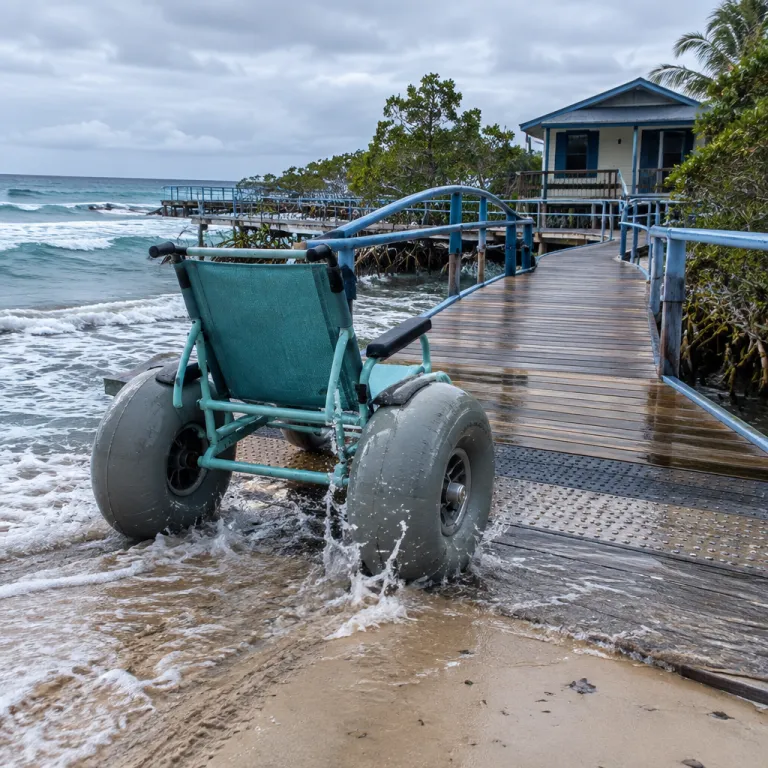
Costa Rica’s Donatapa scheme has quietly transformed the meaning of an accessible beach holiday. The initiative recycles plastic bottle caps into modular boardwalks that create firm, wheelchair accessible paths across soft sand. On the Pacific coast, fifteen beaches now have these Donatapa boardwalks, while two more accessible beaches sit on the Caribbean side, giving couples a genuine choice of coastline.
For travelers searching for accessible hotels Costa Rica wheelchair eco lodge stays, these beaches are a game changer. An eco lodge or beach resort near a Donatapa site can offer accessible rooms that connect via ramps directly to the boardwalk, then onward to the waterline. Many of these beaches also provide accessible amphibious beach wheelchairs, so wheelchair users and guests with disabilities can roll from the hotel, across the boardwalk, and into the ocean with minimal transfers.
Not every hotel near a Donatapa beach is equally prepared, so ask precise questions before you book. Confirm whether the resort can offer accessible transport to the beach, whether the path from rooms to the exit is step free, and whether staff are trained to assist with beach wheelchairs safely. For couples who value both intimacy and independence, the best accessible accommodations will provide accessible showers, grab bars, and space to maneuver inside the room, while the surrounding accessibility features extend your reach to the sea, the pool, and nearby restaurants.
Guanacaste, Playa Conchal, and the Pacific accessible beach circuit
Guanacaste province on the north Pacific coast has become the most consistent region for accessible hotels in Costa Rica. Large resorts near Playa Conchal and other sandy bays often combine extensive accessibility features with strong sustainability programs. You will find accessible rooms with ocean views, step free access to multiple pools, and ramps that link restaurants, spas, and beachfront terraces.
Playa Conchal itself is a useful base for couples who want a refined beach resort with reliable accessibility. Many hotels here provide accessible paths from the lobby to the beach, and some have pool hoists or zero entry pools that allow guests with disabilities to enter the water gradually. When a property chooses to offer accessible experiences seriously, it will usually provide accessible menus, adjustable sun loungers, and staff who understand how to assist wheelchair users without taking over.
From Guanacaste, you can build an accessible travel circuit that includes other Pacific beaches connected by the Donatapa boardwalk network. Look for resorts that offer accessible excursions to nearby wildlife refuges, mangroves, or sunset cruises with ramped boarding. Couples who enjoy design forward city stays may appreciate how these coastal properties echo the refined urban escapes highlighted on this accessible luxury travel guide, but with palm trees, warm surf, and the sound of parakeets at dawn.
Eco-lodges, Arenal Volcano, and the accessibility energy puzzle
The area around Arenal Volcano shows how Costa Rica’s eco lodges are rethinking accessibility in off grid environments. Many properties here rely on solar panels and rainwater harvesting, yet they still need to guarantee stable power for hoists, electric wheelchairs, and medical equipment. The most thoughtful accessible hotels in this region design their energy systems around those non negotiable needs.
When you evaluate an eco lodge near Arenal Volcano, ask how they manage electricity during storms or cloudy periods. A serious property will provide accessible backup power for essential devices and explain clearly where wheelchair users can charge chairs or scooters overnight. Couples should also check whether accessible rooms are on the same level as the main restaurant and pool, because steep slopes can turn a beautiful hillside setting into a daily challenge for guests with mobility issues.
Trails and viewpoints around Arenal are gradually becoming more wheelchair accessible, with some reserves adding compacted paths and gentle gradients. An eco lodge that chooses to offer accessible excursions will often provide accessible transport, portable ramps, and guides trained to support guests with disabilities respectfully. In this region, the phrase “accessible hotels Costa Rica wheelchair eco lodge” often means a property that blends natural materials, low impact lighting, and rain forest immersion with roll in showers, grab bars, and ramps elevators that feel like part of the architecture rather than afterthoughts.
Cloud forests, Manuel Antonio, and regional contrasts
Costa Rica’s cloud forests present a different accessibility profile from the beaches and Arenal’s volcanic slopes. Properties in Monteverde and similar highland areas sit on steep terrain, which complicates the creation of fully wheelchair accessible paths. Some lodges mitigate this with terraced layouts, internal shuttle vehicles, and carefully graded ramps between rooms and shared facilities.
By contrast, Manuel Antonio on the central Pacific coast offers a more compact blend of rainforest and beach. Here, several hotels and small resorts provide accessible rooms with ocean views, step free access to restaurants, and shuttles down to the national park entrance. The best accessible accommodations in Manuel Antonio will provide accessible routes from the lobby to the pool, and some coordinate with local operators who run wheelchair accessible tours inside the park.
Couples deciding between cloud forest and coast should think about how much daily elevation change they can comfortably manage. For wheelchair users and guests with disabilities who prefer smoother gradients, the Pacific beaches and Arenal area usually provide more predictable access. Travelers who have already enjoyed barrier free foliage seasons in places like New England or the Scottish Highlands, as profiled in this guide to accessible lodges, will recognize the same trade off between dramatic scenery and practical accessibility.
Inside the room: what premium accessible accommodations really offer
Luxury in an accessible hotel is not just about thread count or a dramatic pool. For couples, it is the confidence that accessible rooms match standard suites in style, location, and amenities. In Costa Rica, the best properties provide accessible bathrooms with roll in showers, stable seating, and grab bars placed where you actually need them, not where a checklist suggests.
When a resort promises to provide accessible rooms, ask for floor plans or photos that show turning circles, bed heights, and the space under the sink. Couples where one partner has mobility issues often need room for both a wheelchair and a hoist, plus luggage and perhaps a portable shower chair. The most thoughtful hotels will offer accessible wardrobe rails, lowered peepholes, and light switches that can be reached from a seated position, while still maintaining a calm, design led aesthetic.
Shared rooms facilities matter just as much as the private space. Check whether the path from your room to the pool, spa, and restaurant is step free, and whether ramps have handrails and non slip surfaces. Some Costa Rican resorts now offer accessible cabanas, pool hoists, and quiet corners where guests with disabilities can rest away from the main activity, echoing the discreet yet attentive service style seen in refined accessible bed and breakfast stays such as those featured on this Boise travel review.
Logistics, transfers, and choosing the right region
Planning accessible travel in Costa Rica starts with the flight into San José or Liberia. From either airport, you will need an adapted transfer to your hotel, ideally with a lift or sturdy ramp and secure tie downs. Some resorts now work with specialist operators who offer accessible vehicles, while others maintain their own vans equipped for wheelchair users and guests with disabilities.
For couples, the choice between regions often comes down to how much time you want to spend in transit versus at the pool or on the beach. Guanacaste and Playa Conchal are closer to Liberia airport, which reduces transfer times and makes weekend escapes more realistic. The Manuel Antonio area and Arenal Volcano region are more easily reached from San José, but road conditions and traffic can extend journeys, so it is worth asking your hotel for realistic transfer durations.
Within each region, look for properties that offer accessible on site transport, such as golf carts with ramps or low floor shuttles. These services can make a steep driveway or spread out resort feel manageable for guests with mobility issues. When a hotel chooses to offer accessible logistics as part of its core service, you feel it from the moment you clear customs to the evening you roll back to your accessible room after a late swim in the pool.
Key figures on accessibility and sustainable stays in Costa Rica
- Costa Rica currently has fifteen accessible beaches on the Pacific coast and two on the Caribbean coast equipped with Donatapa style boardwalks made from recycled plastic bottle caps, according to reporting by Adventure.com ; this makes it one of the most extensive accessible beach networks in Latin America.
- The country protects more than 25 percent of its land in national parks and reserves, a proportion that creates strong demand for eco lodges and resorts that balance conservation with accessibility for guests with disabilities.
- Tourism accounts for roughly 6 to 8 percent of Costa Rica’s gross domestic product, based on data from the Costa Rican Tourism Board, which incentivizes hotels and resorts to invest in accessibility features that attract international travelers with mobility issues.
- International research from organizations such as the World Tourism Organization indicates that travelers with disabilities often spend up to 30 percent more per trip than the average tourist, a pattern that aligns with the premium positioning of many accessible hotels and eco lodges in Costa Rica.
- Air connectivity through San José and Liberia airports has expanded steadily over the past decade, with dozens of direct routes from North America, which simplifies accessible travel planning for couples seeking long weekend stays at beach resorts or eco lodges near Arenal Volcano and Manuel Antonio.
FAQ about accessible hotels and eco-lodges in Costa Rica
Are eco lodges in Costa Rica genuinely wheelchair accessible or only partially adapted ?
Accessibility varies widely, but a growing number of eco lodges around Arenal Volcano and the Pacific coast now offer fully wheelchair accessible rooms and step free routes. These properties usually combine ramps, wider doors, and roll in showers with reliable power for hoists and electric wheelchairs. Always request detailed photos and written confirmation of accessibility features before booking, because some lodges still use the wheelchair symbol for only partially adapted rooms.
Which regions of Costa Rica are best for couples with mobility issues ?
Guanacaste, including Playa Conchal, and the Manuel Antonio area generally offer the best mix of accessible hotels, beach access, and manageable terrain. These regions have several resorts with accessible rooms, pool hoists, and proximity to Donatapa boardwalk beaches. Cloud forest areas can be more challenging due to steep slopes, so they suit travelers who are comfortable with some elevation changes and assisted transfers.
How can I arrange accessible airport transfers from San José or Liberia ?
Many premium hotels and resorts can arrange adapted transfers with vehicles that have lifts or sturdy ramps and secure tie downs. When you book, specify your wheelchair dimensions, whether you travel in the chair, and any additional equipment such as hoists. It is wise to reconfirm transfer details a few days before arrival, especially during peak travel seasons.
Do accessible beaches in Costa Rica provide amphibious wheelchairs and assistance ?
Several Donatapa boardwalk beaches on the Pacific coast offer amphibious beach wheelchairs that can roll from the boardwalk into the water. Availability and staffing vary by location, so ask your hotel to check in advance and, if possible, reserve a chair. At many sites, trained volunteers or lifeguards can assist with transfers, but couples should still discuss comfort levels and safety routines beforehand.
What should I ask a hotel to verify before booking an accessible room ?
Request exact measurements for door widths, bed height, and bathroom turning space, plus photos of the shower, toilet, and any grab bars. Confirm that there is a step free route from the accessible room to the restaurant, pool, and main exits, and ask whether ramps have handrails and non slip surfaces. If you use powered equipment, verify that the property has reliable electricity, accessible outlets, and backup power for essential devices.